Story from North : COELACANTH: THE ANCIENT FISH THAT RETURNED FROM THE PAST
In the deep sea of Bunaken lies a living mystery once thought to have gone extinct for millions of years. Its name is the coelacanth (pronounced: se-la-kan)—a unique and rare sea creature full of stories. The coelacanth is not just an ordinary fish—it is a symbol of hope and the wonder of nature, now being reintroduced to children through stories and art.
The coelacanth is an ancient fish estimated to have lived for over 400 million years—older than the dinosaurs! Scientists once believed it had gone extinct, until a live specimen was astonishingly discovered off the coast of South Africa in 1938. This discovery shocked the world, like finding a "living treasure" from prehistoric times.
The coelacanth has a distinct appearance: a large body, fins that move like slow legs, and hard, armor-like scales. It dwells in the deep sea and is rarely seen by humans.
But a sad story emerged in 2011 when a photo surfaced of a dead coelacanth found in the waters of Manado. Upon investigation, it was revealed that the fish had died from ingesting plastic waste.
To introduce this fish to children and the wider community, Pelindo Regional 4 Manado, in collaboration with the North Sulawesi Literacy Association (Perkumpulan Literasi Sulut), featured the coelacanth in a children's storybook series: Stories from the North (Cerita dari Utara).
In the book, Pelindo tells a fictional story about a young coelacanth who is curious and eager to explore the Bunaken Sea. One day, it leaves its coral cave and encounters a lionfish—a beautiful creature with long, spiky fins. This meeting opens the young coelacanth’s eyes to the fact that the ocean is not just a playground but a home that must be protected together.
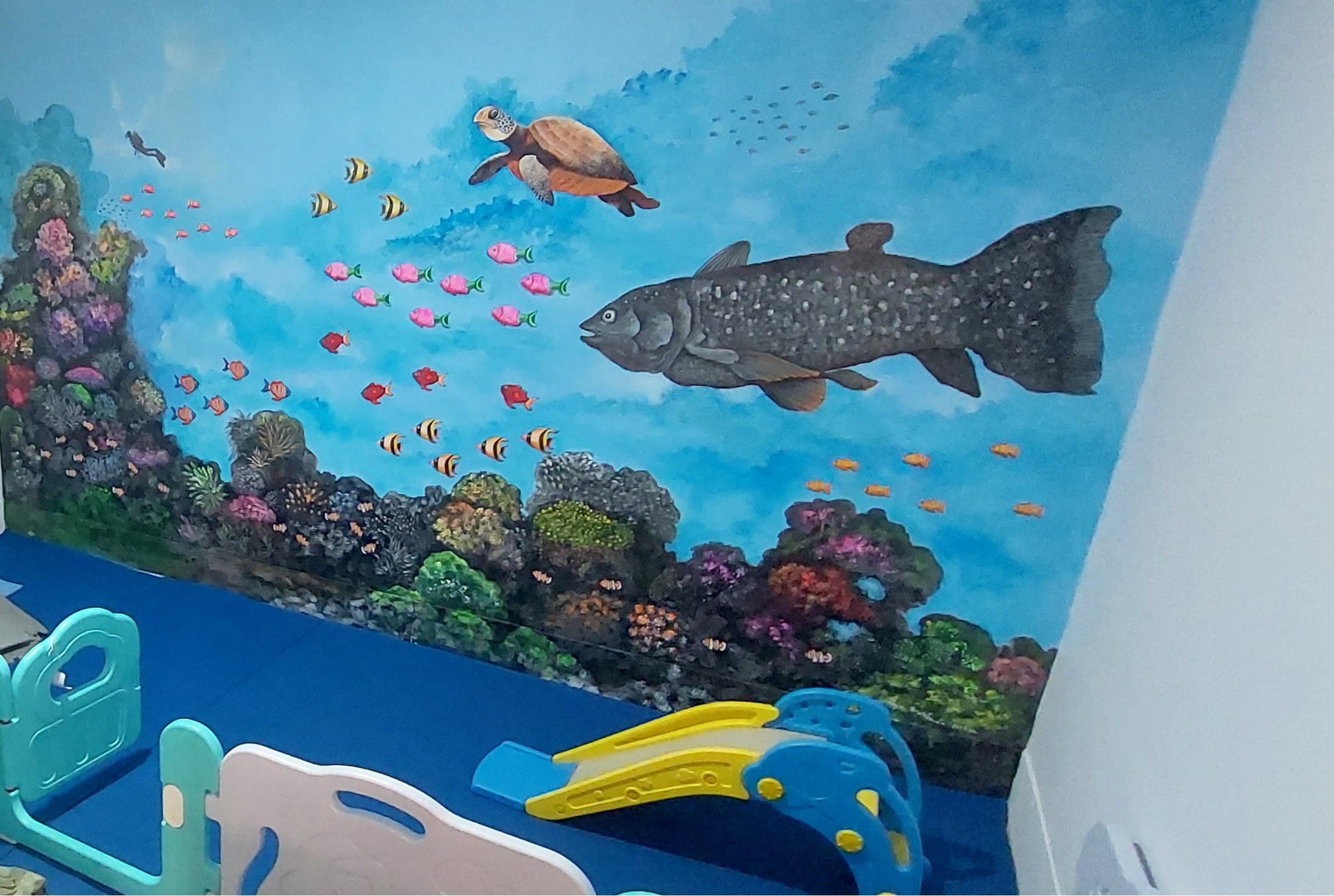
Pelindo also brought the coelacanth to life in an educational mural at the Passenger Terminal Playroom in Manado Port. There, children can see an illustration of the coelacanth side by side with a sea turtle (Tuturuga)—two marine creatures in need of protection.
The coelacanth is not just a relic of history. It is a living reminder that the ocean holds irreplaceable life. And it is our responsibility to protect it—starting today.